Harness checkpoints for domain-specific agents.
Iteron is an open-source substrate for building, evaluating, and governing the harness around each model × task pair. Terminal coding is the first reference implementation.
Pre-alpha software
The ordinary permission gate and macOS/Linux execution sandbox are enabled by default. File-write confinement still has an unresolved symlink race; do not use this pre-alpha build unattended on sensitive repositories. Windows has no code-execution sandbox.
What works today
-
Terminal-first operation
A responsive full-screen TUI plus text, JSON, and stream-JSON interfaces for bounded automation.
-
Provider choice
Anthropic Messages, OpenAI Responses, and OpenAI-compatible Chat adapters, with built-in profiles for six providers.
-
Explicit authority
Capability-based permissions, scoped effects, hard run limits, and macOS/Linux sandbox backends.
-
Durable sessions
Hash-chained local records with continuation, resume, fork, checkpoint, and verification contracts.
Iteron can read, search, and edit a workspace; run explicitly authorized commands; work with Git, web, memory, skills, hooks, and external tool servers; and run a verification command before accepting completion.
Start in five minutes
Install the latest public release on macOS or Linux:
curl --proto '=https' --tlsv1.2 -LsSf https://github.com/Plantcore-AI/Iteron/releases/latest/download/install.sh | sh
Then validate a provider credential and open a repository:
Release v0.0.20 also publishes a Windows x86-64 binary and PowerShell installer; Windows remains unconfined for code execution. Follow Installation and verification, then review permissions and sandbox limitations before using an important repository.
Why Iteron
| Principle | What it means in practice |
|---|---|
| Domain-specific substrate | Each domain can define its model and task profiles, harness policies, evidence, and checkpoints on shared runtime contracts. |
| Bounded runtime | Turns, time, cost, retries, queues, output, and concurrency have explicit ceilings. |
| Authority separation | Strategies can propose work; they cannot grant capabilities or weaken hard constraints. |
| Durable evidence | Sessions, tool events, checkpoints, and verification results remain attributable and inspectable. |
| Provider truth | Model discovery reflects the credentials and capabilities actually available to the operator. |
| Model-task fit | Harness choices are evaluated for a model and task profile instead of being treated as universal defaults. |
| Accountable ownership | Public, machine-checked boundaries connect each subsystem to a responsible human maintainer. |
Harness checkpoints
A model is only one part of an agent system. Context selection, prompts, tools, planning, scheduling, budgets, verification, and recovery can change the result for a particular model and task. Iteron calls a typed, versioned bundle of those choices a harness checkpoint.
The checkpoint thesis guides the architecture while the product remains a straightforward CLI and terminal application. Safety, authority, evidence integrity, and hard resource ceilings stay outside the optimization surface. Read the concept, current search surface, and implementation boundary →
Architecture
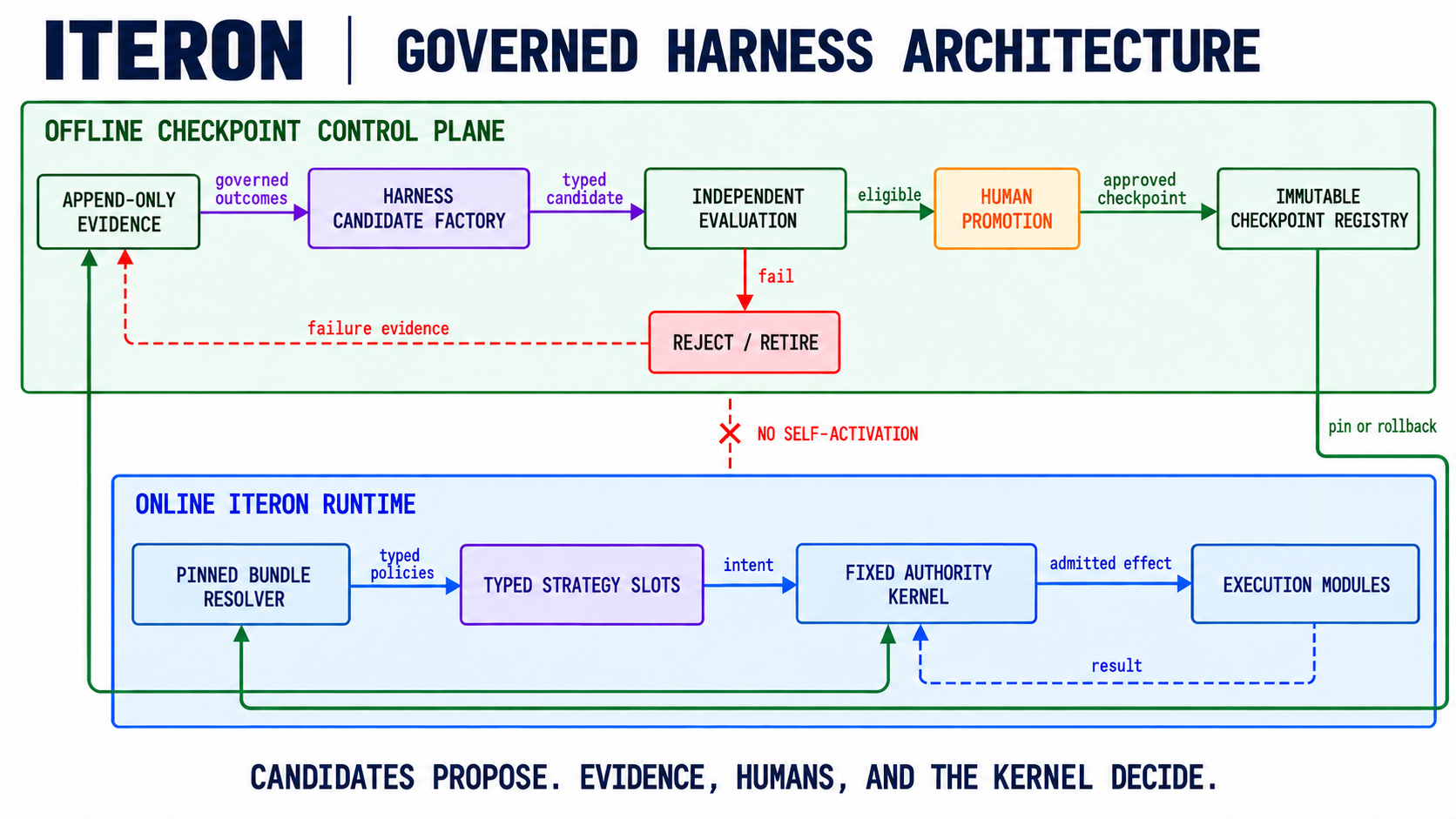
The current codebase is a modular monolith. Source boundaries are machine checked, while concrete composition still lives in the kernel and CLI/TUI. The fixed-kernel layout in the diagram is a target contract and extraction direction, not a shipped microkernel claim. Read the architecture, project status, and roadmap for the current implementation truth and planned work.
Community
Bug fixes, tests, documentation, provider adapters, evaluation fixtures, and carefully scoped features are welcome. Start with the contributor guide and Code of Conduct.

@fr0m-scratch · Creator and Project LeadSets Iteron's direction and holds final human override authority under the public governance contract.
Community contributors
 gomnitrix@gomnitrix
 XZhouuuu@XZhouuuu
 yadonkai@yadonkai
Maintainer count is not fixed. Humans claim coherent module or invariant boundaries, accept ongoing responsibility, and use protected review paths. Read the governance contract and project status.
Explore the documentation
-
Get started
-
Use Iteron
-
Understand the system
-
Build with us